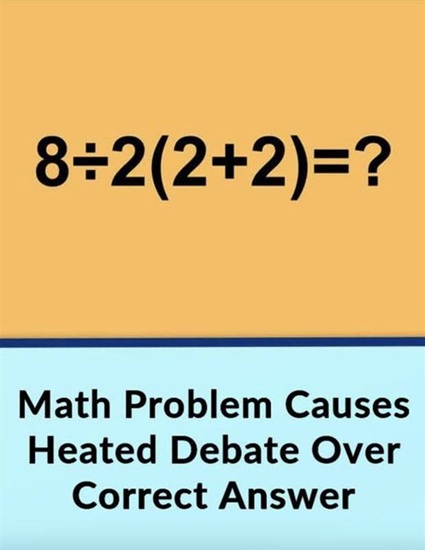
In the age of social media, even simple mathematical expressions can become unexpectedly controversial, sparking widespread debate among users, educators, and professionals across different fields of science and communication. One well-known example is the expression 8 ÷ 2(2 + 2), which circulated widely online and led to intense discussions about the correct application of mathematical conventions and the order of operations in arithmetic.
The debate became popular because different interpretations of the same expression appeared to produce different answers, raising questions about clarity, notation standards, and how mathematical rules are communicated in written form. At its core, the discussion is based on the order of operations, commonly taught through the PEMDAS or BODMAS conventions, which guide the sequence of solving parentheses, exponents, multiplication, division, addition, and subtraction.
According to standard mathematical convention, the first step is to solve the expression inside the parentheses, which simplifies (2 + 2) into 4, leaving the expression as 8 ÷ 2 × 4. From this point, multiplication and division are evaluated from left to right, meaning 8 ÷ 2 is calculated first, resulting in 4, and then multiplied by 4, leading to a final result of 16.This interpretation is widely supported in formal mathematics education because it follows consistent rules designed to avoid ambiguity when expressions are written without additional parentheses.
However, the controversy arises because the expression is written in a way that some readers interpret differently, especially regarding whether multiplication by juxtaposition (2(4)) should be prioritized over division.
Some individuals argue that after simplifying the parentheses, the expression becomes 8 ÷ 2(4), which they interpret as 8 ÷ (2 × 4), leading to a different result of 1.
This disagreement highlights a known issue in mathematical notation: expressions written without explicit grouping symbols can sometimes be ambiguous, even if the underlying rules are consistent.
Educators and mathematicians often emphasize that clarity in writing is essential, recommending additional parentheses to avoid confusion, such as writing either (8 ÷ 2) × (2 + 2) or 8 ÷ [2(2 + 2)].
The viral nature of this problem was amplified by social media platforms, where users with different educational backgrounds and interpretations quickly shared conflicting answers and defended their reasoning.
The debate was not only about mathematics but also about how people understand rules differently, especially when those rules are applied in informal or unclear notation.